1. Introduction
Part 1 of this series examined the background and formation requirements of a UA under the SO (Cap. 151), and principles governing its contractual capacity and liability.
As explained in Part 1, a UA has no separate legal personality. It cannot contract, sue or be sued in its own name. Instead, its rights and obligations are generally determined by applying ordinary principles of contract and agency to the members.
Part 2 addresses tortious liability, internal disputes, property-holding and the procedural difficulties of opening bank accounts, and then compares the pros and cons of the UA structure.
2. Tortious Liability
2.1 Liability under Ordinary Tort Principles
A UA cannot itself commit a tort or bear direct liability due to its lack of legal personality. Liability instead falls on individuals under ordinary tort principles, depending on the circumstances, liability may arise through:
- personal participation in the wrongful act;
- authorisation or direction of that act;
- vicarious liability; or
- breach of a personal duty of care.
Where an office-bearer or a volunteer commits a wrongful act, the courts will examine who authorised it, and whether any legal relationship imposes responsibility on others.
2.2 No Implied Agency from Mere Membership
Membership alone does not create an implied agency relationship or make every member responsible for the acts of other members.
In Hong Kong Kam Lan Koon Ltd v Realray Investments Ltd (HCA 15824/1999), Realray brought a counterclaim for trespass over land, against Mr. Kwan Yau Hang, both in his personal capacity and as representative of all members of Kam Lan Koon (金蘭觀), which was at that time a UA, arguing that the occupation was a “corporate” act of the UA, so that every member was personally liable without any individual act of trespass.
Lam J held that, legally speaking, imposing liability on a member for a tort physically committed by others is not straightforward. Adopting London Association for Protection of Trade v Greenlands Ltd [1916] 2 AC 15, it was held that if liabilities are to be fastened on “any members of such an association, it must be by reason of the acts of those members themselves, or by reason of the acts of their agents; and the agency must be made out by the person who relies on it, for none is implied by the mere fact of association”.
2.3 Practical Risk Management
Office-bearers should actively manage risks by:
- clearly defining the responsibilities of office-bearers, employees and volunteers in the Constitution;
- implementing safety protocols, risk assessments, incident-reporting procedures, particularly for public events, sports, youth programmes;
- recording material operational decisions in meeting minutes; and
- obtaining appropriate insurance.
3. Internal Disputes and the Rule in Foss v Harbottle [1843] 67 ER189
3.1 The Proper Plaintiff Principle
The rule in Foss v Harbottle provides that where a wrong is committed against a company, the company is generally the proper plaintiff to commence proceedings. It also reflects the principle that the courts should not interfere with internal irregularities capable of being approved or ratified by the majority in a general meeting.
These principles prevent unnecessary judicial intervention in matters that can properly be resolved through an organization’s internal procedures.
3.2 Application to UAs
The rule does not apply straightforwardly to UAs because a UA cannot sue in its own name.
In Man Mei Kwai v Man Ping Nam [1999] HKCFI 1036, the Court of First Instance considered an internal dispute involving the Man Sham Chung Wui (文深涌會) (the “Wui”). Its registered manager challenged a tenancy allegedly granted without the required express consent of the Wui. A member counterclaimed that the manager had also let other property without proper authority.
The manager sought to strike out the counterclaim by relying on the rule in Foss v Harbottle. The court refused, noting that the rule does not generally apply to UAs because they cannot sue in their own names. In any event, an individual member may bring proceedings concerning ultra vires acts or the unauthorised use of the association’s funds.
This does not give members an unrestricted right to litigate every internal disagreement. The court will consider whether the member’s proprietary interests have been affected.
4. Property Held on Behalf of UAs
4.1 Holding Property through Trustees or Nominees
A UA cannot hold legal title to land in its own name. Property is therefore commonly registered in the names of trustees, nominees or designated office-bearers for the benefit of its members.
This may cause difficulties when a trustee dies, loses capacity, refuses to transfer the property or claims it as a personal asset. The risk is particularly significant where the governing documents do not clearly record the capacity in which the registered owner holds the property.
4.2 Constructive Trusts and Collective Ownership
In Lam Kwok Hing (as Administrator of the Estate of Lam Ping Sang, deceased) v Lau Ha & Ors [2025] HKCFI 1354, the court considered property acquired for the benefit of the Sha Tin Welfare Association (the “STWA”), a UA managed by the Sha Tin Rural Committee (the “STRC”), which was also a UA.
The property was registered in the names of four village representatives as joint tenants. After the death of the last surviving registered owner, the administrator of his estate claimed possession. The defendants argued that the registered owners had held the property for STWA’s members.
The court dismissed the claim and held that the property was subject to a common intention constructive trust. The common understanding was that the property belonged collectively to STWA’s general body of members. The registered owners were merely nominees entrusted to hold legal title for their benefit, while STRC was authorised to manage the property.
The decision demonstrates that courts may recognise the collective beneficial interests of members even though a UA cannot itself hold legal title. However, such findings depend heavily on the evidence. UAs should not rely on a court subsequently inferring a trust where clear documents could have been prepared at the outset.
4.3 Practical Recommendations
For valuable assets, UAs should appoint trustees and execute a clear trust deed specifying beneficiaries, trustee powers and dealing restrictions. The Constitution should also address asset distribution upon dissolution, preferably for similar charitable purposes.
5. Opening Bank Accounts
Opening a bank account presents practical hurdles for UAs due to their lack of legal personality. Licensed banks in Hong Kong do open accounts for societies registered or exempted under the SO, but onboarding is not automatic. Each bank has a discretion, and due diligence is typically as rigorous as for a limited company.
In practice, banks generally require:
- Official Society Registration: Certificate of Registration (or Exemption) from the HK Police, and the list of office-bearers;
- Governance Documents: Rules, Regulations, or Constitution;
- Identity & Address Proof: Valid IDs and addresses for all Signatories, Beneficial Owners, and Controllers;
- Financial Proof: Proof showing where initial and ongoing funds come from (e.g., membership fees, donations);
- Tax Forms: Signed FATCA (US tax) and CRS forms (if applicable);
- Certified Copies: All copies must be certified by a recognized professional (e.g., lawyer, CPA, Justice of the Peace)
Since UA is not a legal person, banks scrutinize governance documents to establish individual accountability. Applicants may expect longer onboarding timelines than corporate entities.
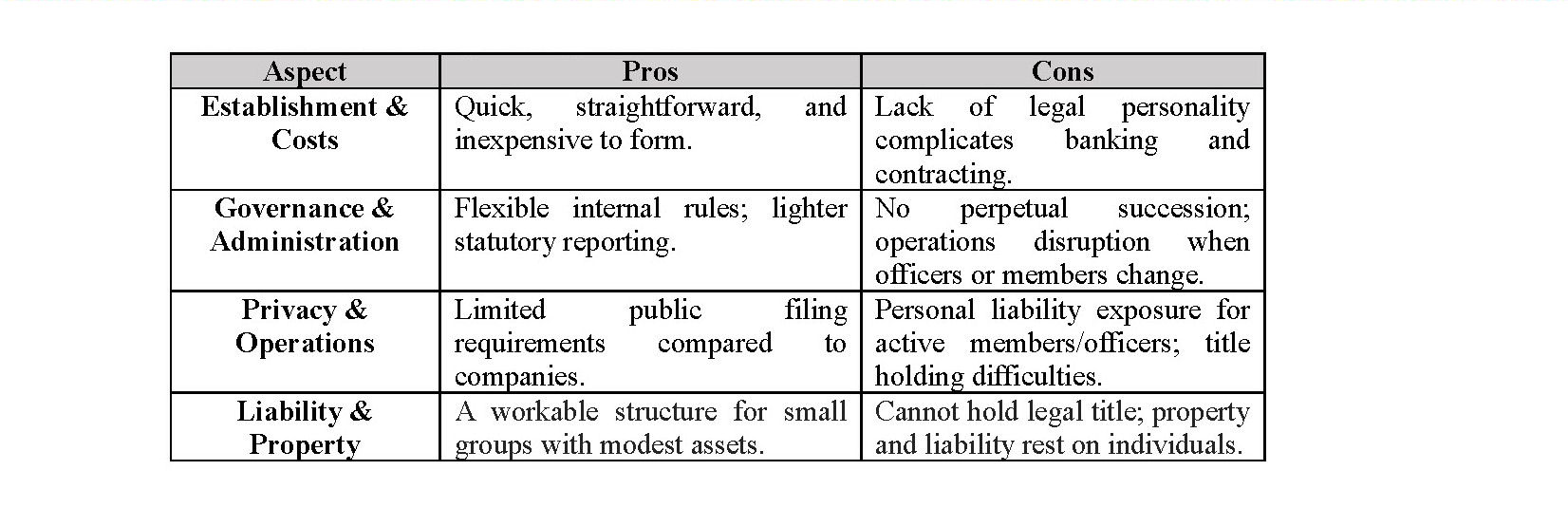
6. Pros and Cons of Operating as a UA
7. Conclusion
This two-part series has outlined the key considerations for NGOs operating as UAs in Hong Kong. While a UA offers a simple, flexible and relatively low-cost structure, its lack of separate legal personality affects its contractual and tortious liability, internal governance, property-holding and ability to open bank accounts.
A UA may suit smaller, community-focused NGOs with modest assets and limited risks. For organisations with employees, valuable property, substantial funding or significant contractual commitments, an incorporated structure, such as a company limited by guarantee, may provide greater protection and continuity.
Founders should therefore consider both their present needs and long-term objectives when choosing a legal structure. Early legal advice is recommended to ensure that appropriate governance and risk-management measures are adopted.